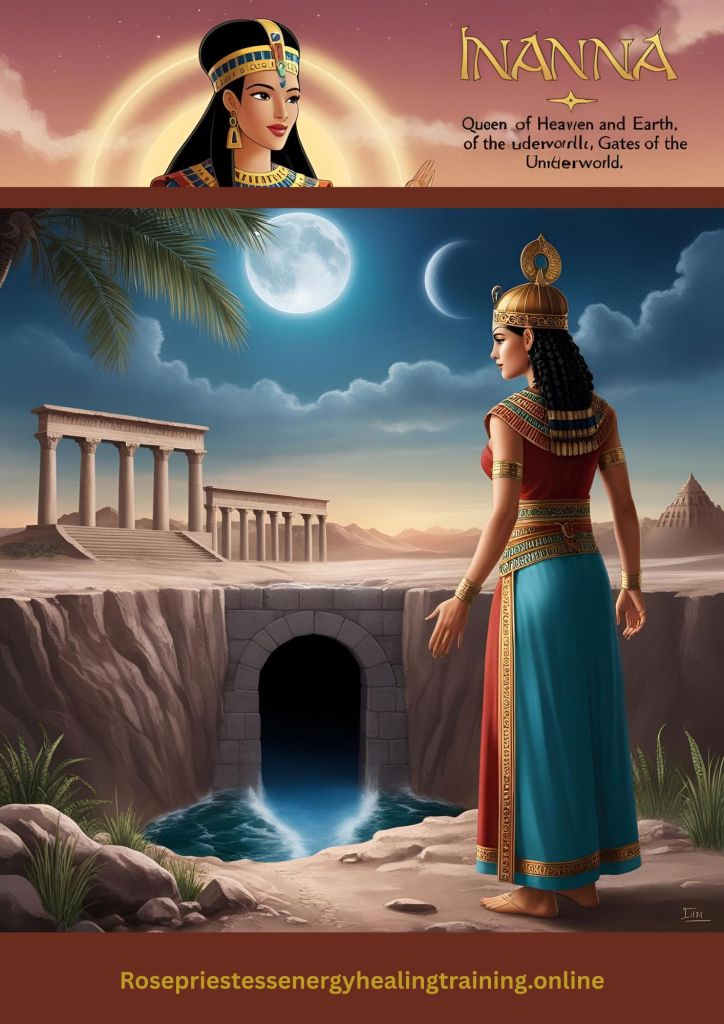
Long before the rise of Christianity and the Abrahamic faiths, long before the resurrection story of Christ entered collective consciousness, there existed an ancient myth from Sumer and Babylon. It was a story of a powerful feminine being—a goddess, a queen, and a high priestess—who descended into the underworld, faced her shadow, and rose again.
Her name was Inanna.
She was known as the Queen of Heaven and Earth. She governed love, war, fertility, and divine wisdom. She was one of the first goddesses to reflect the full spectrum of feminine power—sensual, sovereign, fierce, and deeply connected to the cycles of nature.
This is a story that not only predates the resurrection of Christ by thousands of years (the story is believed to be 6000-8000 years old) but also maps directly onto the celestial movements of the planet Venus, with whom Inanna is intimately linked.

The Myth of Inanna’s Descent
Inanna hears the call to descend to the underworld, the shadow realm ruled by her sister Ereshkigal, the dark goddess of death and mystery. She prepares for her journey by adorning herself in sacred robes, jewels, a crown, and priestess tools—symbols of her divine authority.
But at each of the seven gates of the underworld, Inanna is forced to give up one of her sacred items. By the time she reaches her sister’s throne room, she is naked, humbled, and powerless.
There, she is judged and killed. Her body is hung on a hook for three days and three nights.
Yet this is not the end.
Through divine intervention—some say through her own clever preparation and the help of loyal allies—Inanna is revived. She returns to the world above, reborn and transformed.

Venus and the Path of Descent
This story mirrors the astronomical cycle of Venus. Every 19 months, Venus disappears from the night sky and becomes invisible for approximately 40 days, echoing Inanna’s underworld stay. Just as Inanna dies for three days before being reborn, Venus too is unseen for three days before reappearing as the Morning Star, heralding renewal.
Inanna’s myth is a map of this Venusian journey—one that women, priestesses, and soul-aligned seekers walk to this day: descent, death of the false self, and sacred rebirth.
Inanna, Easter, and the Abrahamic Influence
The Christian holiday of Easter is built upon the same seasonal and symbolic patterns as Inanna’s story. The timing—Spring Equinox through to Easter—is a celebration of the return of life after winter, of light after darkness.
The resurrection of Christ after three days mirrors Inanna’s resurrection. The egg, so commonly associated with Easter, is not originally Christian—it was a fertility symbol tied to Eastre, the Anglo-Saxon goddess of spring, who herself echoes Inanna’s energy.
These ancient themes were adopted and adapted by early religious movements to integrate the deeply rooted pagan wisdom of resurrection, divine feminine power, and the sacred cycles of life.
Shedding the False Self
At the heart of Inanna’s descent is a spiritual truth we all encounter: to walk a path of soul awakening, we must be willing to shed the layers of false identity. Each gate represents a surrender of ego, illusion, and attachment. What remains is the true self—bare, raw, and authentic.
This death is not physical—it is a death of the carnal, selfish, reactive mind that seeks power or approval over truth and love.
And from this death comes rebirth—true healing, divine remembrance, and resurrection into one’s sacred feminine sovereignty.
Reflections in Other Traditions
This path is not exclusive to Inanna. It repeats across traditions and myths:
- Isis resurrects Osiris through love, magic, and divine will.
- Persephone descends to the underworld and returns each spring.
- Mary Magdalene, often misunderstood, stands as a divine witness at Christ’s resurrection—herself a high initiate in the divine feminine mysteries.
- The Phoenix rises from the ashes in countless cultures as a symbol of transformation.
Each myth whispers the same sacred truth: we must descend to rise. We must die to illusion to live in truth.
Walking the Venusian Rose Path
As priestesses, healers, and men and women reclaiming our power, we walk this path cyclically. The movement of Venus is not just celestial—it is mirrored in our lives, our healing work, our soul’s journey. The descent into shadow is not to punish us but to purify us, to strip away what is no longer aligned. We take a look at those things we have suppressed we alchemise them and we rebirth. This is a time of rebirth. How will you rebirth during the Easter period?
We are the modern Inannas, remembering the ancient codes of rebirth. It’s time to acknowledge your Divine Light and Wisdom and share it with your world!!
We are rising.
 Rose Priestess Energy Healing Training Online
Leave a comment