QADASH, Qodosh, Q-D-S
The goddess Qetesh, also spelled Qadesh or Qetesh, was a deity of love, beauty, and sexual pleasure, whose worship was integrated into ancient Egyptian religion during the New Kingdom period (circa 1550–1069 BCE). The name Qetesh stems back to before the New Kingdom and connects to the Khureshi tribe who became monotheistic when Mohammed received his revelation in a cave. Qetesh or Qadesh the Goddess of Love, Beauty and Sexual Pleasure originated from the Near East, possibly from Canaanite or Syrian cultures, her name derives from the Semitic root “Q-D-Š,” meaning “holy” or “blessed.” The name Khadijah has different meanings determind by the culture in which it was used. The name Kadisha or Kadesha is filled with deep meaning and is a representation of the Divine Feminine and the Feminine aspects of the Source Of Divine Light. She is often represented as a woman of high stature much like Marium Magdalena Mary Magdalene who was also a woman of high stature in that she was able to support herself and to contribute to Yahshua/Yashia/Yeshua/Jesus’s ministry. We have to travel pretty far back to find these positive archetypes that represented the Divine Feminine in world history who were respected as equal.
in Islam the Prophet Muhammad’s first wife was Khadija bint Khuwaylid. In Hebrew, her name would likely be pronounced as “Khadijah bat Khuwaylid,” with “bat” meaning “daughter of.” So Khadijah was the daughter of Khuwaylid.
Khuwaylid ibn Asad was a notable Arab merchant of the Quraysh tribe in the 6th century CE, recognized primarily as the father of Khadijah bint Khuwaylid, the first wife of the Prophet Muhammad. He was a successful businessman, and his daughter Khadijah inherited his wealth and business acumen, becoming a prominent merchant herself. Khuwaylid died around 585 CE during the Ḥarb al-Fijār (“Sacrilegious War”).
Khadijah bint Khuwaylid, the first wife of Prophet Muhammad (pbuh), played a pivotal role during their 25-year marriage. A successful and esteemed merchant in Mecca, she was impressed by Muhammad’s integrity and business acumen, leading her to propose marriage. Their union was marked by mutual respect and deep affection. Khadijah was the first to believe in Muhammad’s prophethood, offering unwavering support during the early, challenging years of his mission. She provided both emotional encouragement and financial resources, enabling the nascent Muslim community to withstand persecution. Together, they had six children: two sons, who died in infancy, and four daughters—Zainab, Ruqayyah, Umm Kulthum, and Fatimah. Khadijah’s steadfastness and dedication have solidified her legacy as a revered figure in Islamic history. Here the name Khadijah represents an educated and talented woman who was financially independent and a devotee to the teachings of Islam and Mohammed (pbuh)
Muhammad was born around 570AD into the Quraysh tribe in Arabia. The people were polytheistic and worshipped many gods within their tribes. Muhmmad received a revelation and began to preach that there was one God and he angered the Quraysh tribe in Makkah. Muhammad left Makkah to live in Madinah.There was a war in Makkah between Muhammad and the Quraysh tribe, and Muhammad won. He smashed all the statues of gods in the Ka’aba, teaching Muslims that they should believe in one God, Allah.
https://www.bbc.co.uk/bitesize/guides/zd6w7p3/revision/3
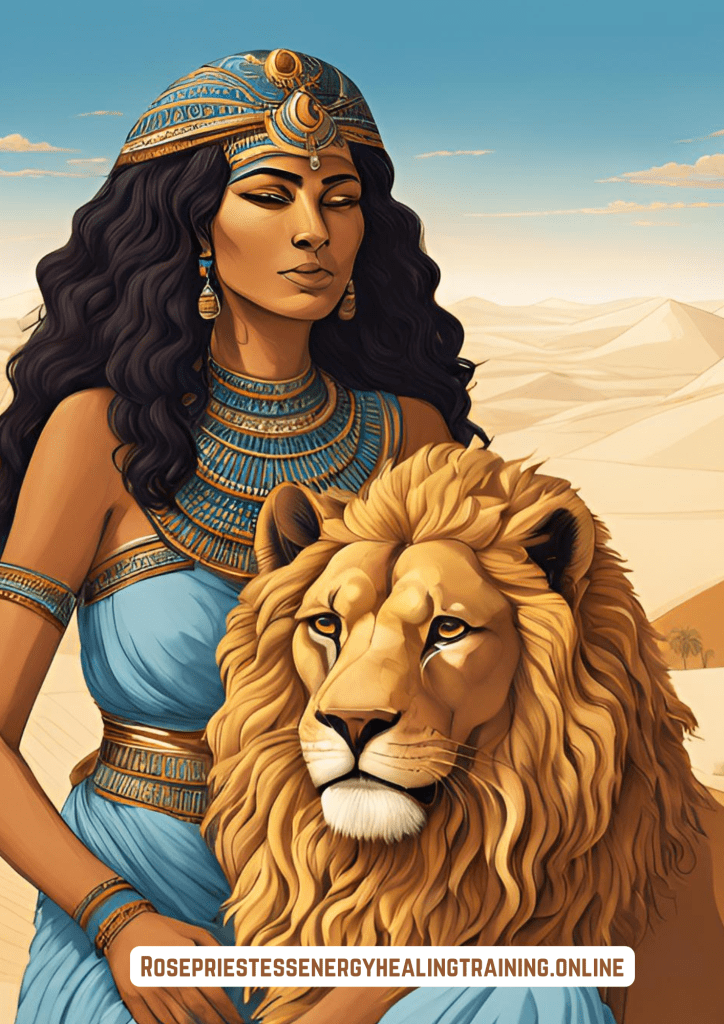
In Egyptian art, Qetesh is often depicted as a nude woman standing or riding upon a lion, holding symbols such as flowers, mirrors, or serpents. This iconography emphasizes her associations with eroticism and fertility. Qetesh was likely to have been one of the Goddesses worshiped at that time and possibly a representation of Anat the goddess of warfare the counterpart to Ba’al. Anat was often depicted with Istarte/Ishtar. During the Arabian Pre Islamic Polytheistic times the main God was believed to have 3 daughters known as
- Al-Lat: Known as “the Goddess,” Al-Lat was associated with war, peace, combat, and prosperity. She was widely venerated across the Arabian Peninsula, including in Mecca, and was often represented by uncut stones. Wikipedia
- Al-Uzza: Meaning “the Mighty,” Al-Uzza was a goddess of fertility, love, and war. She was one of the most revered deities in Mecca and was also worshipped as an uncut stone. Thaliatook
- Manat: Associated with fate and destiny, Manat was another prominent goddess in the pre-Islamic Arabian pantheon. She, too, was worshipped as an uncut stone and held significant importance in Meccan society.
Qetesh the representation of a form of the Divine Feminine was sometimes considered a form of the Egyptian goddess Hathor, reflecting her integration into the Egyptian pantheon. The name Qetesh or Kadesh appears to stem back to the times predating Islam as Khadijah was older than Mohammed (pbuh) I had an image of a woman hugging lions the archetype Kadesha up on my wall for years not knowing that it was her. I used to channel her energy over a decade ago, the image was a woman hugging lions, Kadesha as an archetype is a bad ass fierce warrior woman who is filled with wisdom, she is able to tame wild lions and beasts, she can fight and heal. She can build up or tare down she is the holder of the wisdom of alchemy i.e Sophia Wisdom. As always I look at the archetype behind the Goddesses depicted in history and Kadisha, Khadisha, Kedisha appears to be a strong educated woman who knows herself, is self sufficient yet willing to unite with her Divine Masculine counterpart as equals.
Get this.. there is even a Valley called the Kadisha Valley where the Cedars Of Lebanon grow within the Bsharri and Zgharta Districts of the North Governorate of Lebanon. The Kadisha valley lies at the foot of Mount al-Makmal in northern Lebanon.Within this valley resides the “Cedars of God” (Arabic: أرز الربّ, Arz ar-Rabb), The Cedars Of God i.e the Cedars Of Lebanon are mentioned in the Epic of Gilgamesh. Cedar trees have been utilized by numerous civilizations, such as the Phoenicians, Egyptians, and Israelites, for constructing temples, ships, and other significant structures. The valley where the Cedars grow is considered Holy and we find the name Kadisha describing this.
The Kadisha valley is surrounded by cliffs, caves and rock-cut monasteries, some dating back over a millennium, serving as places of refuge and worship. The combination of its natural beauty and spiritual heritage led to the Kadisha Valley and the Forest of the Cedars of God being designated as a UNESCO World Heritage Site in 1998.
Today, the Kadisha Valley and the Cedars of God continue to be cherished for their cultural, historical, and ecological significance, attracting visitors and pilgrims from around the world who seek to experience their profound heritage and natural splendor.
Qodesh, Kadesh, Kadisha signifies holiness. Ancient scripts often capture these meanings visually. For example, in the Paleo-Hebrew alphabet, many letters have pictographic forms:
(The pictorial Hebrew Alphabet Aleph Beit is significant to get the full spectrum of the meaning of words if you wish to go deeper so it is here for your reference)
- Aleph (𐤀) – Represented as an ox head, symbolizing strength and leadership.
- Bet (𐤁) – Depicted as a house, denoting shelter and home.
- Gimel (𐤂) – Resembles a camel, suggesting movement and provision.
- Dalet (𐤃) – Shaped like a door, a threshold to transformation.
- He (𐤄) – Represents a window or breath, signifying life and spirit.
- Waw (𐤅) – A simple hook, symbolizing connection.
- Zayin (𐤆) – Often shown as a weapon, representing strength and protection.
- Het (𐤇) – A fence, indicating enclosure and separation.
- Tet (𐤈) – A basket, symbolizing containment and nourishment.
- Yod (𐤉) – Depicted as a hand, denoting action and power.
- Kaph (𐤊) – Represents the palm of the hand, a symbol of giving.
- Lamed (𐤋) – An ox-goad, signifying guidance and discipline.
- Mem (𐤌) – Symbolizes water, the essence of life.
- Nun (𐤍) – Depicted as a fish, representing movement and continuity.
- Samekh (𐤎) – A supportive structure, implying protection.
- Ayin (𐤏) – An eye, the window to the soul.
- Pe (𐤐) – A mouth, representing communication.
- Tsade (𐤑) – A hook, signifying purpose and direction.
- Qof (𐤒) – Often depicted with intricate detail, holding mystery and hidden light.\n- Resh (𐤓) – Represents the head, symbolizing leadership and wisdom.
- Shin (𐤔) – Resembles teeth, denoting transformation and energy release.
- Tav (𐤕) – A mark or cross, symbolizing completion and divine order.
The sacred name “Kadesha” or “Qadosh” is formed from these letters K-D-S which at their root mean Holy.
Ka is the letter Kaph which represents a hand and transformation.
Da is the letter Dalet which represents a door and the Pineal Gland as a vehicle for transformation.
Sha is the letter Shin which represents transformation and energy release.
In my Ancient Hebrew studies the letter “S” is Sa, Sameth representing a thorn, to grab hate or protect depending on the context that it is used. Below I explore the hidden meaning of Kadash, Kadesh. In the ancient Paleo-Hebrew there was no “Q” or Qoph it was Ka
Ka is open palm, to bend, open
Da is door, move, hang, entrance
Sa is thorn, protect
Ruach Ha Qodosh means Holy Spirit and within the word we have the Qodosh, Qadesh we have the K D S. The word Holy is the root of the word QDS, Kadesh, Kodosh, there were no seperate vowel sounds in ancient Hebrew so K D S could be kadesh, Kidesh, Kodesh, Kudesh.
Holy Spirit is a term used in several Semitic languages with each language having its own script. Let’s explore some of them further below:
1. Hebrew:
- Modern Hebrew Script: “רוח הקודש” (Ruach HaKodesh)
- Pronunciation: roo-akh ha-ko-desh
- Meaning: “Spirit of Holiness”
- Ancient Hebrew (Paleo-Hebrew) Script: 𐤓𐤅𐤄 𐤇𐤒𐤃𐤔
- Note: Paleo-Hebrew script was used in ancient Israel before being replaced by the Aramaic script.
2. Aramaic:
- Script: “רוחא דקודשא” (Rukha d’Qudsha)
- Pronunciation: roo-khah dah kood-shah
- Meaning: “Spirit of Holiness”
3. Arabic:
- Script: “الروح القدس” (Al-Ruh Al-Qudus)
- Pronunciation: al-rooh al-qudus
- Meaning: “The Holy Spirit”
These terms reflect the linguistic and cultural nuances of each language while conveying the concept of the Holy Spirit.
Holy Spirit
- Hebrew: רוּחַ הַקֹּדֶשׁ
(Ruach HaKodesh) - Aramaic: ܪܘܚܐ ܕܩܘܕܫܐ
(Ruḥa d-Qudsha) - Yiddish: דער הייליקער גייסט
(Der heyliker geyst) - Paleo-Hebrew: (𐤓𐤅𐤇 𐤄𐤒𐤃𐤔)
(Pictographic form corresponding to Ruach HaKodesh) - Latin: Spiritus Sanctus
For deep meditation and spiritual study we can take the word Kodesh and study it based on the varying Semitic languages. If I take the word Hakodesh the Ha is the breathe the Ka is the hand the D is the door and the Sa is transformation meaning the word Kadesh could mean the breath is the door to transformation, it could also mean the Holy Spirit is the Breathe of YAHUAH (GOD)


Leave a Reply